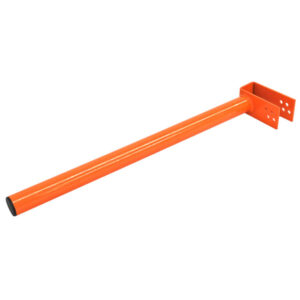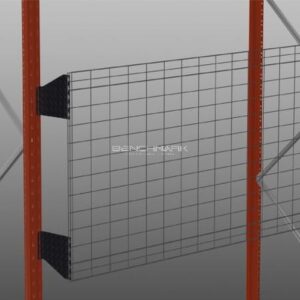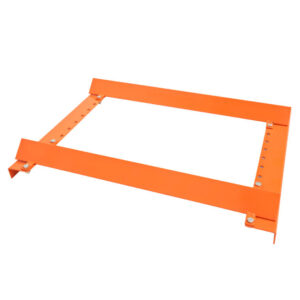
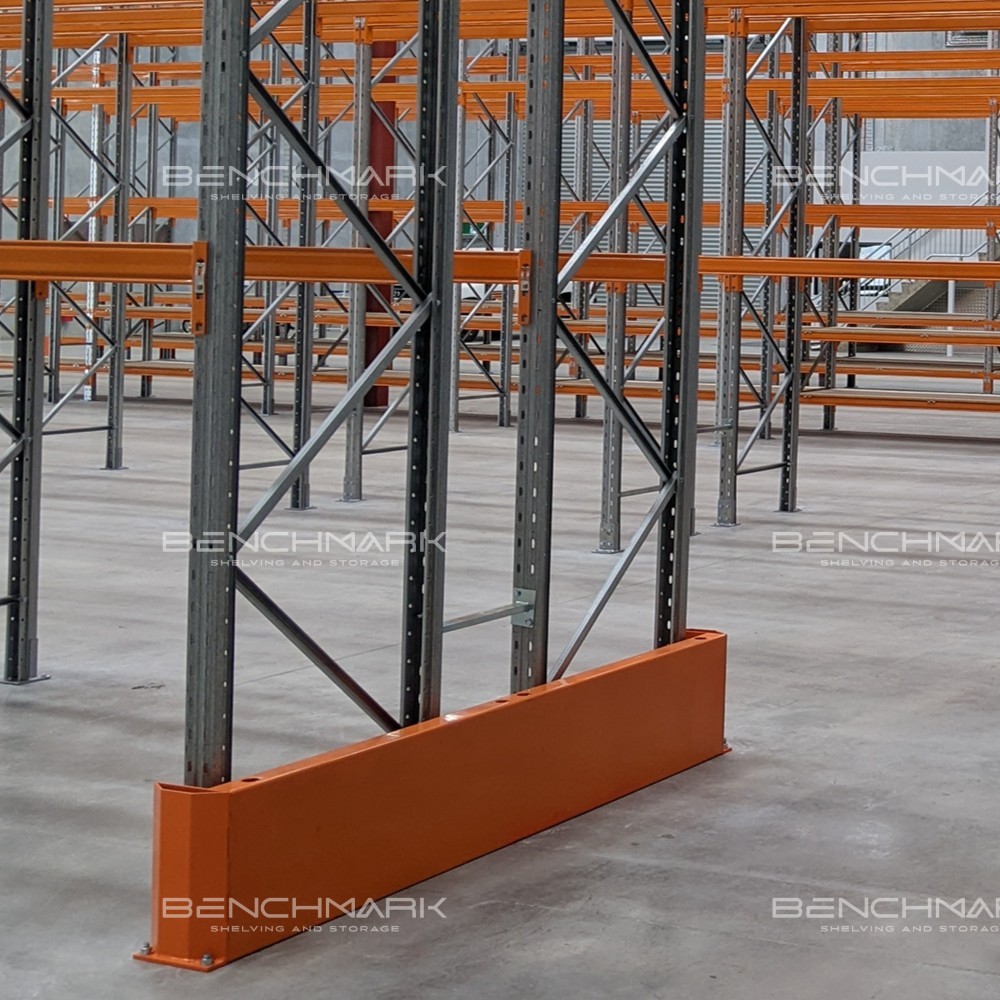


End row wrap protectors or Rack End Protector (REP) are specifically engineered to shield pallet racking aisle ends from accidental forklift impacts. Manufactured from heavy-duty steel and featuring a full plate fascia panel, these barriers deliver superior strength and coverage. Suitable for both single- and double-entry racking configurations, they provide reliable, high-performance protection in demanding warehouse environments.
| Size: | 1090mm, 1470mm, 2360mm, 2530mm |
|---|---|
| Finish | Powder Coat, Hot Dipped Galvanised |
| Height: | 400mm |
| Depth: | 225mm |
| Overall Length: | 1090mm – for 838mm frame
1470mm – for 1219mm frame or 838mm frame with 250mm Stand-off 2360mm – 838mm frame back-to-back with 430mm row spacer 2530mm – 838mm frame back-to-back with 610mm row spacer Other sizes are available on request to suit different depth racking |
| Column Type: | End Row Barrier Protection |
| Finish Options: | Powder Coated Orange for indoor application
Hot Dipped Galvanised for outdoor application |
What is an End Row Wrap Barrier?
An End Row Wrap Barrier, often referred to as a Rack End Protector (REP) is installed at the end of pallet racking aisles. Its purpose is to shield the full depth of the racking frame from low-level impacts, typically caused by forklifts maneuvering in and out of aisles. These barriers are particularly important in high-traffic warehouse environments where turning movements are frequent.
Should I choose powder-coated or galvanised End Row Wrap Barriers?
The best finish depends on where the barrier will be used. Powder-coated safety orange is commonly preferred for indoor warehouse settings due to its high visibility, helping operators clearly identify rack locations. For environments exposed to moisture, chemicals, or outdoor conditions—such as cold storage facilities or loading docks hot-dip galvanised (HDG) barriers are recommended for their superior resistance to corrosion.
How do I select the correct barrier length for my racking?
Choosing the right length depends on your racking configuration, including frame depth and whether the system is single-entry, fitted with mesh backing, or arranged back-to-back. The following options are available:
1090mm – Suits single-entry 838mm frames
1470mm – Suitable for single-entry 1219mm frames or 838mm frames with 250mm mesh stand-off
2360mm – Designed for back-to-back 838mm frames with a 430mm row spacer
2530mm – Designed for back-to-back 838mm frames with a 610mm row spacer
What are the anchoring requirements?
Due to the potential for high-impact collisions at aisle ends, secure installation is critical. Barriers should be fixed using either M14 screw anchors or M16 stud anchors, embedded to a minimum depth of 65mm into the concrete slab. Smaller anchors, such as M10 or M12, are not suitable and should not be used, as they do not provide the necessary strength for these applications.
How many anchors are required per barrier?
Each barrier includes multiple fixing points to allow installation flexibility, but a minimum number of anchors must be used to ensure proper performance:
1090mm & 1470mm barriers – 6 fixing points provided; minimum of 4 anchors required
2360mm & 2530mm barriers – 8 fixing points provided; minimum of 6 anchors required
Meeting these minimum requirements is essential to ensure the barrier can effectively absorb and redirect impact forces away from the racking structure.
How far should the barrier be installed from the racking uprights?
A minimum clearance of 60mm must be maintained between the barrier and the racking columns to ensure proper performance and compliance.
Are End Row Wrap Barriers mandatory in Australian warehouses?
Yes. Under AS4084.1:2023 standards, rack protection such as upright guards is required at aisle ends and intersections. These locations present the highest risk for forklift collisions, making protective barriers a necessary safety measure for compliance.